In a perfect world, the BoC would be raising interest rates to normal levels because the domestic part of the Canadian economy (ie., mostly consumers) don't need them - we didn't suffer a major recession like the US, our housing market has continued to grow and we don't have record high unemployment either. Problem is, the BoC cannot raise interest rates because if it did it would send the C$ up rapidly and hurt the already struggling export side of our economy.
Faced with this dilemma, the only course of action the BoC really has to slow debt growth (without raising rates) is to "talk up" the risks of too much debt using moral suasion. Judging by the way the media always takes a "sky is falling" approach to stories like these - see here - I'd say the moral suasion approach could work for the Bank if only because the media's focus on Canada's debt to income ratio being higher than the US is misleading and scares the daylights out of most people! (especially those who think this is what caused the US economy to topple over two years ago.)
But the reality is, our personal debt situation in Canada is hardly as bad is its being made out to be and nothing compared to what got the US in trouble a couple of years ago. Don't get me wrong, recent debt growth in Canada is unsustainable and some households are very close to financial capitulation. But the main problem with the debt to income ratio is that it compares a "stock" variable like debt with a "flow" variable like income. That's like comparing apples to oranges.
A more meaningful measure is a comparison between a stock variable like debt (your mortgage and other credit) and a stock variable like total assets (ie., your house, your investments, your cash etc). On that score, the chart below shows that debt ratios in the US outpaced Canada dramatically at the height of its housing bubble (and still does today despite the deleveraging that is going on in its economy). Again, I have to emphasize that we should not be unconcerned about Canadian personal debt levels - they are still at record high levels even on a debt to asset basis. But Canada is certainly nothing like the US was in 2007 and a high personal debt to income ratio in and of itself, is not a recipe for disaster.
Tuesday, December 14, 2010
Friday, December 3, 2010
Canada's labour market cooling off in-line with the economy
I just took a quick look at the details of the November job report in Canada. You can find the actual release here. Unfortunately, I think the media is going to get the interpretation wrong on this one and focus in on the better unemployment rate figure - it dropped considerably from 7.9% to 7.6% during the month and is now at its lowest point in almost two years.
But this lower unemployment rate needs to be put into perspective as it comes mainly from a contraction in the labour force. Meanwhile, actual job growth was only 15K during November. And what is slightly troubling is that they were all part time jobs, as there was actually a loss of 12K full time jobs during the month. In fact, the 3 month trend rate of job growth in Canada has slipped from about 70K during the summer to a currently paultry 5K. Combined with the tepid economic growth we saw in the third quarter, its pretty clear that Canada's economic recovery has entered a soft patch that is unlikely to significantly turnaround for at least another 6-8 months.
In such a sluggish environment, it would be completely justifiable for the Bank of Canada to remain on an "extended hold" with rate hikes until the second half of next year.
But as soft as the Canadian job numbers were in August, it looks as if the US job numbers were once again, more disappointing. Only 39K jobs were created there and the US unemployment rate ticked up to 9.8%. At this pace, its going to take a really long time for the US economy to re-coup the jobs it lost during the Great Recession and an even longer time for its unemployment rate to return to a "full employment level" of around 5%. This is in sharp contrast to Canada, where all the jobs lost during the recession have already been recouped.
But this lower unemployment rate needs to be put into perspective as it comes mainly from a contraction in the labour force. Meanwhile, actual job growth was only 15K during November. And what is slightly troubling is that they were all part time jobs, as there was actually a loss of 12K full time jobs during the month. In fact, the 3 month trend rate of job growth in Canada has slipped from about 70K during the summer to a currently paultry 5K. Combined with the tepid economic growth we saw in the third quarter, its pretty clear that Canada's economic recovery has entered a soft patch that is unlikely to significantly turnaround for at least another 6-8 months.
In such a sluggish environment, it would be completely justifiable for the Bank of Canada to remain on an "extended hold" with rate hikes until the second half of next year.
But as soft as the Canadian job numbers were in August, it looks as if the US job numbers were once again, more disappointing. Only 39K jobs were created there and the US unemployment rate ticked up to 9.8%. At this pace, its going to take a really long time for the US economy to re-coup the jobs it lost during the Great Recession and an even longer time for its unemployment rate to return to a "full employment level" of around 5%. This is in sharp contrast to Canada, where all the jobs lost during the recession have already been recouped.
Tuesday, November 30, 2010
Canadian economy downshifts
After roaring ahead in the first half of 2010, the Canadian economy slowed down considerably in the third quarter, with an annualized growth rate of just 1.0% - this is slightly below what most economists had expected and is also below the 2.5% pace registered by the US economy during the quarter.
Implications
With economic growth downshifting to a below trend rate after blistering ahead through the initial stages of the recovery, Canada is joining the"modest economic growth club" (aka the rest of the developed world.) For 2010 as whole, growth looks like it will come in at roughly 3% in Canada which should only slightly outpace the 2.8% growth rate expected in the US. In 2011, growth in Canada and the US is projected to be 2.4% and 2.3% respectively, again not terribly different in terms of the aggregate picture, with both countries growing below their potential. Given the slower pace of Canadian growth, I think its a good bet that the Bank of Canada will hold off on resuming any rate hikes until the second half of 2011.
Some Perspective
Despite the subpar headline GDP number , its important to keep in mind that the major source of the slowdown in the Canadian economy is due to external factors. In particular, weak exports to the US and higher imports act as a considerable drag on a small open economy like Canada. In contrast, the domestic side of the economy has continued to perform well, particularly compared to the US, whose domestic economy continues to cope with deleveraging and severely bruised banking sector:
Going forward, it looks like the Canadian economy will have to continue relying on domestic demand to support overall growth given the weakness in the rest of the world. This is a major reason why the Bank of Canada will be forced to keep interest rates low, as this will provide some necessary cushion to keep supporting domestic spending. Of course, domestic demand will still cool down from its current outsized levels, if only because of exhausted demand in the previously booming housing market. But let's be clear about one thing - Canada's stable mortgage market and banking system should prevent this housing slowdown from evolving into a US-style "capitulation" that would have secondary "knock off" effects in the rest of the economy.
As expected, much of the weakness in Canada in Q3 was with the external side of the economy with exports slipping by 5% (reflecting weak US demand) and imports rising 6.4% (reflecting strong Canadian demand for foreign goods). The overstretched housing sector in Canada also contributed to the Q3 slowdown as residential construction fell by 5.3% in Q3.
But outside of residential construction, domestic conditions in the Canadian economy have remained solid, with consumer spending up 3.5% ( the gain was widespread across spending categories suggesting that the consumer remains confident.) Perhaps the most encouraging development was that the Canadian business sector reawakened in the the third quarter with business investment in machinery and equipment up by a whopping 29%. This likely reflects the impact of a high Canadian dollar, which makes the costs of imported capital equipment from the US cheaper.
Implications
With economic growth downshifting to a below trend rate after blistering ahead through the initial stages of the recovery, Canada is joining the"modest economic growth club" (aka the rest of the developed world.) For 2010 as whole, growth looks like it will come in at roughly 3% in Canada which should only slightly outpace the 2.8% growth rate expected in the US. In 2011, growth in Canada and the US is projected to be 2.4% and 2.3% respectively, again not terribly different in terms of the aggregate picture, with both countries growing below their potential. Given the slower pace of Canadian growth, I think its a good bet that the Bank of Canada will hold off on resuming any rate hikes until the second half of 2011.
Some Perspective
Despite the subpar headline GDP number , its important to keep in mind that the major source of the slowdown in the Canadian economy is due to external factors. In particular, weak exports to the US and higher imports act as a considerable drag on a small open economy like Canada. In contrast, the domestic side of the economy has continued to perform well, particularly compared to the US, whose domestic economy continues to cope with deleveraging and severely bruised banking sector:
Going forward, it looks like the Canadian economy will have to continue relying on domestic demand to support overall growth given the weakness in the rest of the world. This is a major reason why the Bank of Canada will be forced to keep interest rates low, as this will provide some necessary cushion to keep supporting domestic spending. Of course, domestic demand will still cool down from its current outsized levels, if only because of exhausted demand in the previously booming housing market. But let's be clear about one thing - Canada's stable mortgage market and banking system should prevent this housing slowdown from evolving into a US-style "capitulation" that would have secondary "knock off" effects in the rest of the economy.
Wednesday, November 24, 2010
No inflation problem in Canada
As reported here, inflation in October surprised on the upside in Canada. But let's not get too excited about this - the inflationary monster is hardly about to rear its ugly head!
To be sure, there was some surprisingly larger than normal increases in some of the categories monitored by Stats Can in October (especially clothing, insurance, textbooks and autos). Higher energy prices were also at play and we know how volatile they can be. But when you really scrub the CPI data, you hardly get any real common theme that suggests inflationary pressure is building on a wide range of goods and services. If anything, I think the surprise in October should really be viewed as a "one off" and more a reflection of the past firmness in the domestic economy than anything else.
In fact, the forward looking indicators suggest that there is little motivation for excessive inflation to take hold. For example, GDP growth in Canada has slowed down significantly to below its potential rates so its not strong enough to absorb the huge amount of excess slack that still lingers in the economy since the 2008 recession. As any business owner realizes, when you have considerable excess capacity and only moderate demand for your products, you hardly have any power to raise your prices.
Another factor for Canada is the higher loonie which should make the costs of imported goods cheaper. There are time lags for this factor to take effect on a retail level, but competition should ensure that it will happen over the next several months.
Now, I do think there are some isolated areas where we will continue to see some upward pricing pressure building. But many of these areas like hydro and the lingering effects of the HST are legislated and not really indicative of market forces. So when you put it all together, the core rate of inflation (which strips away the volatile effects of energy and taxes) should remain below 2% in Canada for quite some time. Since this is the inflation measure that the Bank of Canada watches and it continues to sit below the midpoint of the Bank's target range of 1-3% , I think it gives the central bank enough room to hold off on rate hikes for at least the next 6-8 months.
To be sure, there was some surprisingly larger than normal increases in some of the categories monitored by Stats Can in October (especially clothing, insurance, textbooks and autos). Higher energy prices were also at play and we know how volatile they can be. But when you really scrub the CPI data, you hardly get any real common theme that suggests inflationary pressure is building on a wide range of goods and services. If anything, I think the surprise in October should really be viewed as a "one off" and more a reflection of the past firmness in the domestic economy than anything else.
In fact, the forward looking indicators suggest that there is little motivation for excessive inflation to take hold. For example, GDP growth in Canada has slowed down significantly to below its potential rates so its not strong enough to absorb the huge amount of excess slack that still lingers in the economy since the 2008 recession. As any business owner realizes, when you have considerable excess capacity and only moderate demand for your products, you hardly have any power to raise your prices.
Another factor for Canada is the higher loonie which should make the costs of imported goods cheaper. There are time lags for this factor to take effect on a retail level, but competition should ensure that it will happen over the next several months.
Now, I do think there are some isolated areas where we will continue to see some upward pricing pressure building. But many of these areas like hydro and the lingering effects of the HST are legislated and not really indicative of market forces. So when you put it all together, the core rate of inflation (which strips away the volatile effects of energy and taxes) should remain below 2% in Canada for quite some time. Since this is the inflation measure that the Bank of Canada watches and it continues to sit below the midpoint of the Bank's target range of 1-3% , I think it gives the central bank enough room to hold off on rate hikes for at least the next 6-8 months.
Friday, November 19, 2010
How the Fed is trying to rebrand "QE"
The concept of "quantitative easing" (QE) is increasingly entering the public lexicon. Unfortunately, there really seems to be alot of confusion about what QE actually is - and this rather funny video reflects that:
Let's be clear that the Bank of Canada has not engaged in QE so a Canadian discussion about the concept is somewhat irrelevant. But I think what really scares people most about "quantitative easing" is that it raises fears that the Fed is somehow overstepping its traditional boundaries and racking up colossal amounts of debt. I supose that faced with this growing backlash, Ben Bernanke and Co. are now trying to "rebrand" QE in order to dim the spotlight away from it (kind of like the public relations measures Maple Leaf Foods used with the tainted meat scandal a few years ago). Effectively, Ben is trying to remind the public that QE, despite its cryptic name, is nothing more than the purchase of securities like long term bonds with newly created money to keep interest rates low and supportive to the economic recovery - something that has always been a tool of central banks. Of course, as the chart below shows, the magnitude of QE today is huge with the Fed's balance sheet expected to peak at a whopping $3 trillion by 2011!! For context, prior to the financial crisis, the Fed's balance sheet was a slim $800 billion:
The most significant downside risk of such a hefty balance sheet, and what should concern people the most about it, is that the excessive liquidity it creates in the banking system could fuel uncomfortably high inflation at some point in the future when the economy is near full capacity again. Of course, an inflation problem in the US a number of years from now should be a much smaller concern than the risk of the world's largest economy slipping back into recession at present, which would have immediate repurcussions for other countries, especially Canada. So worrying about inflation is kind of like worrying about cancer just after you've gone through open heart surgery! Perhaps if the Fed's "rebranding" campaign attempted to telegraph this message a little better, it might also make QE just a bit more palatable.
Let's be clear that the Bank of Canada has not engaged in QE so a Canadian discussion about the concept is somewhat irrelevant. But I think what really scares people most about "quantitative easing" is that it raises fears that the Fed is somehow overstepping its traditional boundaries and racking up colossal amounts of debt. I supose that faced with this growing backlash, Ben Bernanke and Co. are now trying to "rebrand" QE in order to dim the spotlight away from it (kind of like the public relations measures Maple Leaf Foods used with the tainted meat scandal a few years ago). Effectively, Ben is trying to remind the public that QE, despite its cryptic name, is nothing more than the purchase of securities like long term bonds with newly created money to keep interest rates low and supportive to the economic recovery - something that has always been a tool of central banks. Of course, as the chart below shows, the magnitude of QE today is huge with the Fed's balance sheet expected to peak at a whopping $3 trillion by 2011!! For context, prior to the financial crisis, the Fed's balance sheet was a slim $800 billion:
The most significant downside risk of such a hefty balance sheet, and what should concern people the most about it, is that the excessive liquidity it creates in the banking system could fuel uncomfortably high inflation at some point in the future when the economy is near full capacity again. Of course, an inflation problem in the US a number of years from now should be a much smaller concern than the risk of the world's largest economy slipping back into recession at present, which would have immediate repurcussions for other countries, especially Canada. So worrying about inflation is kind of like worrying about cancer just after you've gone through open heart surgery! Perhaps if the Fed's "rebranding" campaign attempted to telegraph this message a little better, it might also make QE just a bit more palatable.
Wednesday, November 17, 2010
This is what a "soft landing" looks like
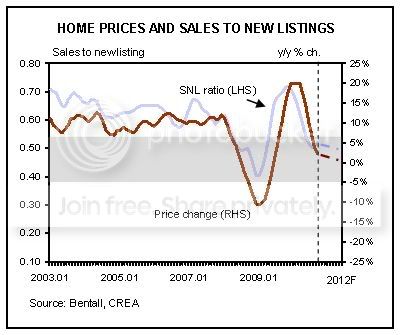
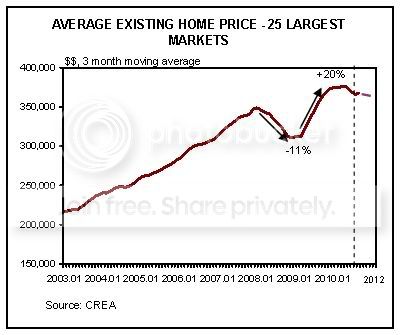
The Canadian Real Estate Board reported earlier this week that resale housing sales perked up a bit in October. So far the cumulative gain in sales since July is about 13% but this comes after a 30% drop such that sales are still down 21% from their peak levels reached in December 2009. Meanwhile, new listings also rose but only by a modest 1%. As a result, the ratio of sales to listings (effectively a measure of supply and demand in the housing market) was about 0.52.
So why is this important? Well, if we think back to economics 101, price growth in a competitive market is determined by supply and demand forces. As indicated above, the supply and demand conditions in Canada's housing market have returned to what most economists believe is a "balanced" range between 0.40 and 0.55. This suggests that market conditions neither favours "buyers" or "sellers" and is consistent with housing price growth of 0% (+/- 2%).
In my view, existing economic fundamentals are likely to keep market conditions in this range going forward. Here's my reasoning: On the demand side, two opposing forces are at work. While the continuation of low mortgage rates remains highly attractive and provides a great deal of support to potential buyers, a significant amount of housing demand has already been brought forward over the last few years. This is likely to prevent a material increase or decline in sales activity.
On the supply side, there is very little reason to expect that new listings will significantly outpace demand in Canada. Unlike some American markets, foreclosure activity has been very rare here and most existing homeowners in Canada are not in dire need to sell (and tend to only do so when the price is right.) This could obviously change if there was a significant increase in interest rates that resulted in refinancing risks for some over leveraged homeowners or if there was a surge in unemployment. I don't expect either of these developements to occur. So to me, its likely that sales and listings could stay in a balanced region for some time. This also likely means that the housing market in Canada is going to be somewhat "boring" over the next while, with neither siginificant price increases like we saw last year or, massive losses like some US markets have seen since their bubble burst.
Welcome!
Welcome to my economic analysis blog! What I hope to do in the weeks and months to come is to simply provide readers with some concise and easy to understand analysis of abstract economic data specific to Canada and use that to derive some practical everyday fundamental implications. I will try to also pay close attention to developments in the housing market since many of us have had direct experience with this area over the past few years.
Of course, there's alot of information and discussion about housing all over the web these days, especially given what has occured in US markets. But what I want to try and do is provide a uniquely Canadian, and unbiased tilt to my analysis and where possible, address some of the "myths" that often develop when a subject like housing gains such "notoriety!" This was exactly the approach I tried to take with some of the work I did earlier in my career.
So I hope you enjoy my posts and hopefully it stimulates some stimulating discussion as well, so feel free to post your comments.
Of course, there's alot of information and discussion about housing all over the web these days, especially given what has occured in US markets. But what I want to try and do is provide a uniquely Canadian, and unbiased tilt to my analysis and where possible, address some of the "myths" that often develop when a subject like housing gains such "notoriety!" This was exactly the approach I tried to take with some of the work I did earlier in my career.
So I hope you enjoy my posts and hopefully it stimulates some stimulating discussion as well, so feel free to post your comments.
Subscribe to:
Comments (Atom)