So why is this important? Well, if we think back to economics 101, price growth in a competitive market is determined by supply and demand forces. As indicated above, the supply and demand conditions in Canada's housing market have returned to what most economists believe is a "balanced" range between 0.40 and 0.55. This suggests that market conditions neither favours "buyers" or "sellers" and is consistent with housing price growth of 0% (+/- 2%).
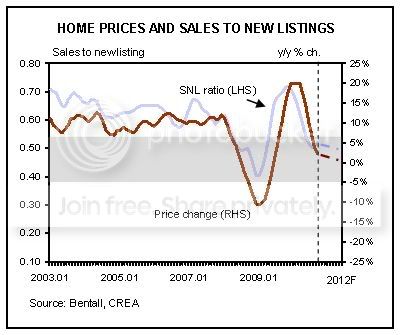
In my view, existing economic fundamentals are likely to keep market conditions in this range going forward. Here's my reasoning: On the demand side, two opposing forces are at work. While the continuation of low mortgage rates remains highly attractive and provides a great deal of support to potential buyers, a significant amount of housing demand has already been brought forward over the last few years. This is likely to prevent a material increase or decline in sales activity.
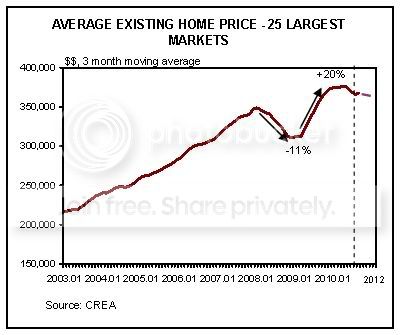
On the supply side, there is very little reason to expect that new listings will significantly outpace demand in Canada. Unlike some American markets, foreclosure activity has been very rare here and most existing homeowners in Canada are not in dire need to sell (and tend to only do so when the price is right.) This could obviously change if there was a significant increase in interest rates that resulted in refinancing risks for some over leveraged homeowners or if there was a surge in unemployment. I don't expect either of these developements to occur. So to me, its likely that sales and listings could stay in a balanced region for some time. This also likely means that the housing market in Canada is going to be somewhat "boring" over the next while, with neither siginificant price increases like we saw last year or, massive losses like some US markets have seen since their bubble burst.

Hi Carl,
ReplyDeleteI attended the REIN meeting last night. Great presentation! Looking at the Real Tronto House Price Value Analysis I noticed that between 1988 - 1991 the housing market was "overvalued" however comparing that to the sales vs new listings chart that same period indicated that it was a buyer's market. Won't a buyer's market indicate that properties should be undervalued?
Chris
chris.e.ho@gmail.com
Good catch Chris - the mis-match between sales and listings and price growth 88-91 was a strong indicator why the Toronto housing market was in a bubble back then. Essentially, prices were rising even faster than the underlying fundamentals would have necessitated (likely reflecting speculation). This doesn't appear to be as much of the case today in Toronto.
ReplyDelete